Building an AI Research Assistant with AgentRuntime
Research is one of the highest-value targets for AI automation. A task that takes a human analyst 4 hours — reading a company's filings, summarizing their competitive position, mapping their tech stack from job postings, identifying recent news — can be executed by an AI agent in 15 minutes with comparable depth.
The difficulty is not getting the AI to perform individual research tasks. It is building the infrastructure to do it reliably, at scale, with output you can trust.
The research workflow structure
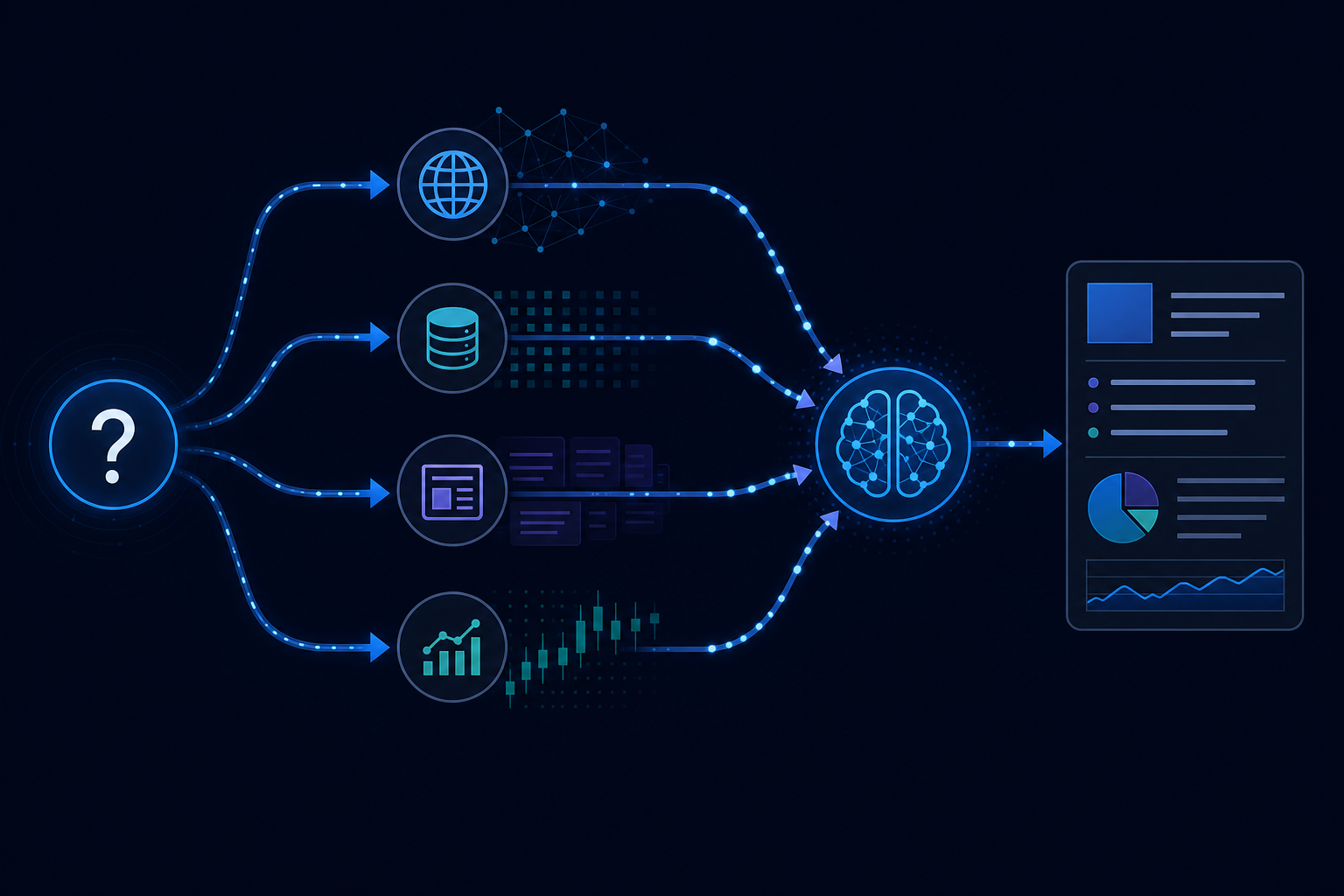
A production AI research assistant has four core phases:
1. Query decomposition Break the research question into specific, answerable sub-questions. "Give me a competitive analysis of this company" is not a good tool input — it is an instruction that produces a generic response. "What is this company's Series C valuation and lead investor?" is a specific, answerable query that produces a reliable result.
An LLM step that takes the research question and produces a structured list of specific sub-queries is the highest-leverage component of the workflow. The quality of the sub-queries determines the quality of the research.
2. Parallel information gathering Execute the sub-queries in parallel: web search, news API, LinkedIn company data, financial databases, job posting analysis. Each source is a separate tool call with its own retry policy.
Not all sources are available for all companies. The workflow should be designed for partial completion — if LinkedIn data is unavailable, the research continues with the data that is available, and the output notes the missing source.
3. Synthesis Pass the gathered information to a synthesis LLM step that produces the final research output. The synthesis prompt should specify the exact output structure — competitive positioning, financials, technology signals, recent developments — and instruct the model to note confidence levels and missing data explicitly.
The synthesis step should use a frontier model. This is the step where quality directly impacts the value of the output, and it is the right place to spend model budget.
4. Citation and confidence annotation The output should be annotated with sources: every claim should be traceable to a specific data source. This is both a quality signal (claims with no source are inferences, not facts) and a usability feature (the reader can verify any claim in seconds).
The reliability requirements
Rate limits across data sources: a research workflow hits multiple external APIs simultaneously. Each has its own rate limits and error modes. Each tool call needs its own retry policy.
Output quality validation: research outputs that contain confident-sounding claims with no supporting source are worse than no output — they can lead to bad decisions. Add a validation step that checks the output for unsourced claims and routes them to the confidence-flagged section rather than the findings section.
Cost control per research request: a research workflow with many parallel tool calls and multiple LLM steps has variable cost depending on the research target. Add cost estimation and a per-request budget — some research tasks may hit data sources that are expensive at scale.
The human-in-the-loop integration
For high-stakes research — investment decisions, competitive intelligence, due diligence — the AI research output should be a starting point for human review, not a final product. Build the workflow to surface the research in a structured review interface, with sources visible alongside claims, flagged uncertainties highlighted, and the ability to trigger additional investigation on specific points.
This framing — AI as a research accelerator, not a research replacement — is the one that gets adopted.
AgentRuntime handles the parallel tool call architecture of research workflows natively: fan-out to multiple data sources, per-source retry policies, partial completion handling, and structured output validation. Join the waitlist for early access.