Multi-Tenant AI Infrastructure: Isolating Workflows Across Customers
If you are building an AI product that serves multiple customers — a SaaS platform, an enterprise software company, an agency — your agent infrastructure needs to be multi-tenant from the beginning. Retrofitting multi-tenancy into an existing single-tenant system is one of the most expensive re-engineering projects a team can take on.
This post covers what multi-tenancy means for AI workflow infrastructure, the failure modes of naive implementations, and the architectural patterns that work.
What multi-tenancy means in practice
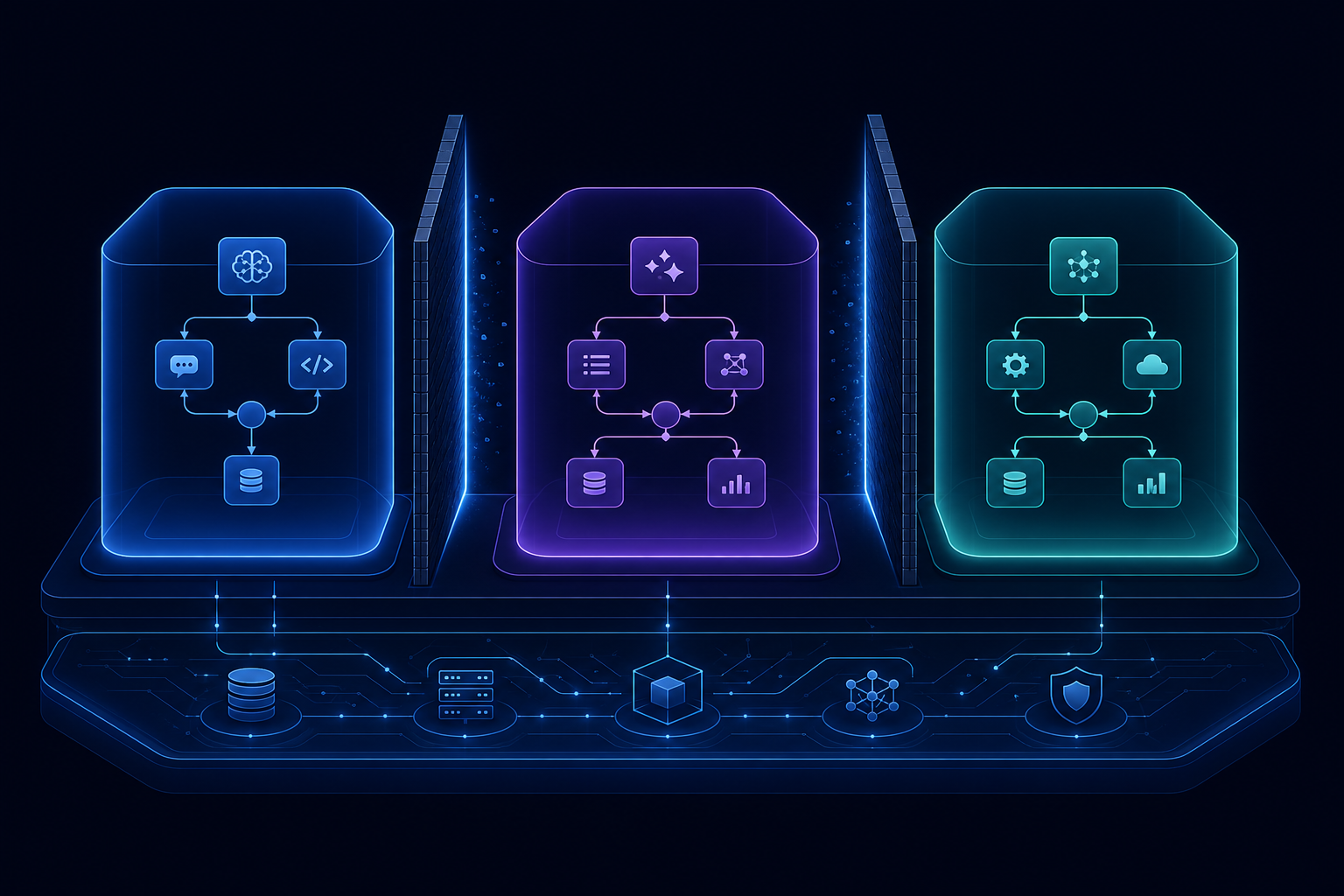
A multi-tenant AI infrastructure means that multiple customers share the same underlying infrastructure — the same workflow engine, the same message brokers, the same observability stack — but each customer's data, credentials, and execution are completely isolated from every other customer's.
Isolation must hold across:
- Data — Customer A cannot read Customer B's workflow definitions, run history, inputs, or outputs
- Execution — A high-volume customer cannot degrade the performance experienced by other customers
- Credentials — Customer A's API keys are not accessible to Customer B's workflows
- Observability — Logs and traces for Customer A's runs do not appear in Customer B's dashboards
Breaking any of these is a serious incident, either a security breach (data leakage) or an availability problem (noisy neighbour).
The naive approach and why it fails
The most common naive implementation is a single deployment with a tenant ID column in the database. All runs go into the same table, filtered by tenant_id. All events go through the same message broker topics. All credentials live in the same secrets manager path.
This works until it does not:
At the database level: A slow query from a high-volume tenant holds locks that delay other tenants. Without proper indexing and query isolation, one tenant's load affects everyone.
At the message broker level: A single event stream means one tenant's burst traffic can starve other tenants of processing capacity. Consumer groups help, but a truly noisy tenant with a large backlog creates tail latency for all.
At the credential level: If a single vault path compromise can expose all tenants' credentials, your isolation is theoretical rather than actual.
At the observability level: Without tenant-scoped log streams and trace filtering, a security review or a debugging session exposes other tenants' data to whoever is doing the review.
The patterns that work
Stream-level tenant isolation
Rather than routing all events through a shared stream, give each tenant isolated stream prefixes. In Redis Streams, this looks like tenant:{id}:workflow:events rather than workflow:events. Consumer groups per tenant mean that one tenant's backlog has no effect on another tenant's processing latency.
This is additive infrastructure: a new tenant is onboarded by creating their stream namespace. Removing a tenant is clean namespace deletion.
Per-tenant credential scopes
Credentials in a secrets manager should be scoped under tenant-specific paths: vault/data/{tenant_id}/mcp/{tool_id}. This means:
- A breach of one tenant's secret path does not expose another's
- Access control policies can be written per tenant
- Audit logs show which tenant accessed which credential
Tenant context propagation
Every event, log line, and trace span should carry the tenant identifier. This is not just for filtering — it is for accountability. When you receive a security inquiry or a compliance audit request for a specific tenant, you need to be able to produce all data associated with that tenant cleanly and completely.
In practice: every API request carries a tenant header that is injected into the context at the entry point and propagated through all downstream processing, including log structured data and OpenTelemetry span attributes.
Execution limits per tenant
Multi-tenancy without execution limits is one noisy neighbour away from a service degradation incident. Each tenant should have configurable limits:
- Concurrent run limit: how many workflow runs can this tenant have in flight simultaneously
- Rate limits: how many workflow starts per minute
- Resource limits: maximum workflow execution time per run
These limits protect other tenants from being affected by one tenant's unusual load patterns, and they protect you from unexpected infrastructure costs when a tenant runs a batch job that is 10x their normal volume.
The SLA challenge
In a multi-tenant system, your SLA is only as strong as your worst-performing isolation boundary. If one tenant can reliably degrade another tenant's throughput, your 99.9% uptime guarantee is effectively a 99.9% uptime guarantee for the average case, not for any specific tenant in the presence of load from others.
Production multi-tenant AI infrastructure requires explicit SLO monitoring per tenant — not just aggregate uptime, but per-tenant throughput, latency, and error rates. When a tenant is consistently at their limit, that is a signal to have a conversation about plan upgrades, not a signal to ignore until they start affecting other tenants.
Starting right
The architectural changes required to move from single-tenant to multi-tenant infrastructure are significant. The right time to make them is before you have customers, not after.
The three things to get right from the start:
- Tenant-scoped event streams — isolate message passing per tenant from day one
- Credential namespacing — never store credentials in a shared path
- Tenant context propagation — every event, log, and span carries the tenant identifier
Everything else can be added incrementally. These three are structural decisions that are expensive to retrofit.
AgentRuntime uses isolated Redis Stream prefixes per tenant, HashiCorp Vault credential namespacing, and tenant-scoped OpenTelemetry context propagation. Multi-tenancy is a first-class design constraint, not an afterthought. Learn more in the documentation or join the waitlist.