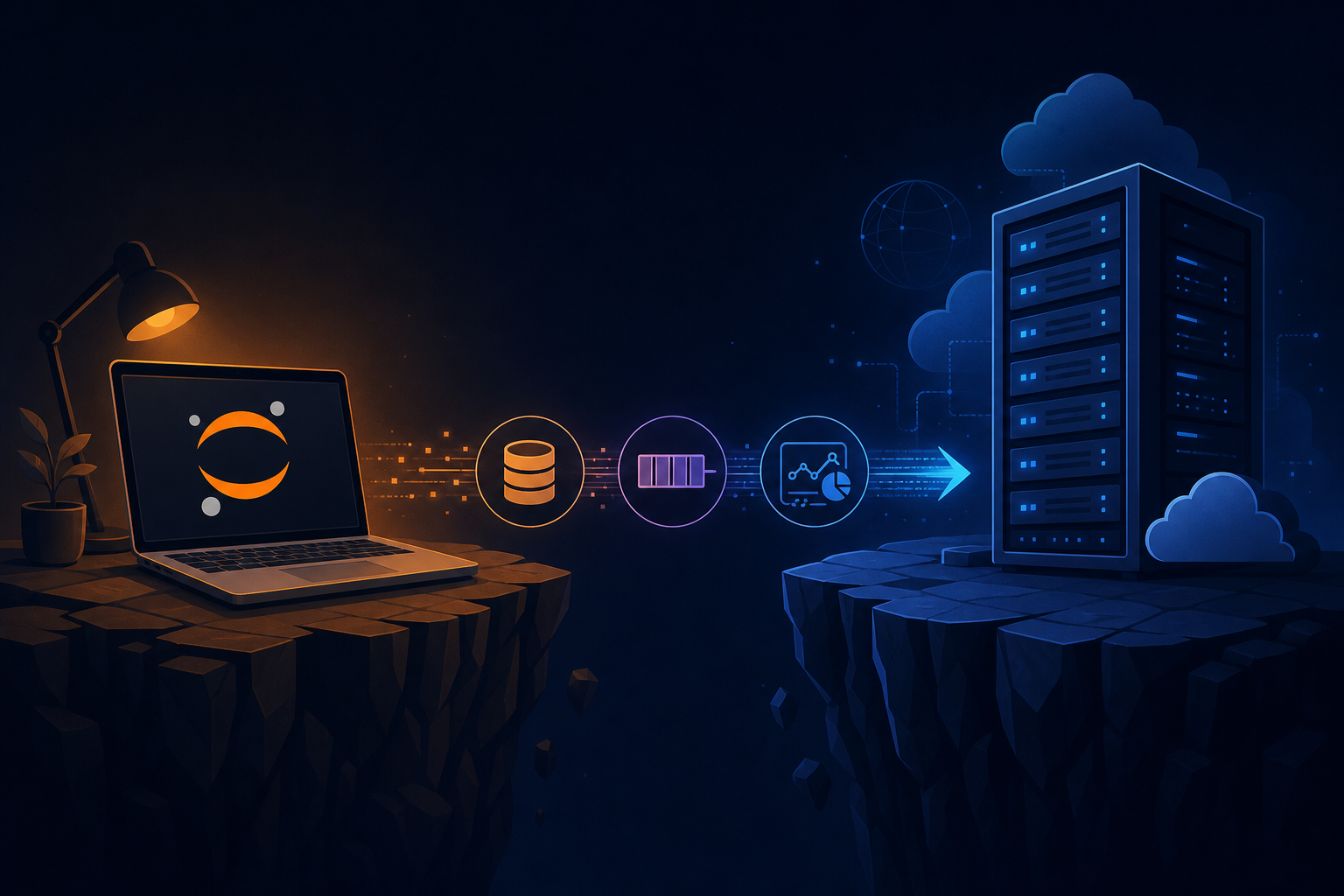
From Notebook to Production: The AI Agent Deployment Gap
The fastest path to a working AI agent is a Jupyter notebook. You call the LLM, chain a few tool calls, iterate on the prompt, and in an afternoon you have something that demonstrably works.
The gap between that notebook and a production system is where most AI projects stall. Not because the logic is wrong, but because the notebook solved a different problem than production requires.
What the notebook doesn't model
A notebook runs one input at a time, synchronously, with you watching. It has no concept of:
- Concurrent runs — what happens when a thousand users trigger the same workflow simultaneously
- Partial failures — what happens when step 3 fails after steps 1 and 2 have already taken irreversible actions
- State persistence — where run state lives when the Python process is not running
- Operational visibility — how you know what is happening and why when you are not watching
- Authentication — how credentials are managed without a
.envfile on your laptop - Deployment — how the workflow runs somewhere other than your machine
None of these are problems in a notebook. All of them are problems in production, and most of them cannot be solved by "putting the notebook in a Docker container."
The temptation to wrap it in a web server
The common intermediate step: take the notebook logic, put it in a function, call that function from a FastAPI endpoint, deploy it. This handles concurrency at the cost of durability — multiple requests can run, but a crashed process loses all in-flight state.
For stateless operations this is fine. For multi-step workflows where steps have side effects — sending an email, updating a CRM, charging a card — it is not. A process restart mid-workflow leaves you with no record of what completed and no way to resume.
The migration checklist
Moving from a notebook to production requires explicit decisions on each of these:
State management: where does run state live? It needs to survive process restarts. A database, not in-memory variables.
Idempotency: if a step runs twice because of a retry or a crash recovery, does it produce the correct result, or does it cause duplicate actions?
Error handling: when a step fails, what happens? Is the run retried from the beginning, from the failing step, or routed to a dead-letter queue for human review?
Observability: for every production run, can you answer "what happened, step by step, and how long did each step take"? If not, debugging is archaeology.
Credential management: are secrets in a vault, or in environment variables on a server somewhere?
Concurrency model: how many runs can execute simultaneously? Is there back-pressure when the queue is full?
Human gates: for actions that require approval before proceeding, how does the workflow pause and resume?
The hidden cost of the DIY path
Teams that go through this migration process manually typically spend six to twelve weeks building infrastructure before they can ship their first production workflow reliably. This is not wasted work — it produces a working system. But it is also not work that differentiates the product. It is the same set of infrastructure problems every AI-powered product needs to solve.
The question worth asking early is whether this infrastructure should be built or adopted. The answer depends on team size, existing platform investment, and how central workflow orchestration is to the product. But it is a question — not an assumption.
AgentRuntime is the production runtime layer for AI workflows: durable execution, step-committed state, built-in observability, and human task management, so your team can move from notebook to production without rebuilding infrastructure from scratch. Join the waitlist for early access.